
Bioavailability explained simply: Why not everything we take in actually works
There is often a significant gap between „ingested“ and „absorbed“. What bioavailability means, why so much is lost – and the three factors that determine whether an active ingredient is truly effective.

The label features a large number. 10,000 mg here, 500 mg there. It suggests that more is better. But between what one takes, and what the body actually records, ... there is often a surprisingly large gap.
The technical term for this gap is Bioavailability – and it is perhaps the most important, yet most frequently overlooked, factor in any dietary supplement.
What bioavailability means
Bioavailability describes the proportion of an ingested substance that actually reaches the bloodstream – and is available there in an active form. The reference value is direct administration into a vein: by definition, this is considered to be 100% bioavailable. Anything that passes through the gastrointestinal tract falls below this – sometimes by a narrow margin, sometimes by a significant amount.
Why so much gets lost when you're on the move
The journey from the mouth to the bloodstream is an obstacle course. Stomach acid, digestive enzymes, the absorption capacity of the intestinal wall and, finally, the liver, which breaks down much of it immediately (the so-called first-pass effect) – at every stage, some of it is lost.
Three examples illustrate just how significant these differences are:
- Curcumin from turmeric: practically insoluble in water and scarcely absorbed in the gut – its bioavailability is close to zero. Only piperine from black pepper increases it by up to 2,000-fold (Shoba et al., 1998).
- Non-hydrolysed collagen: absorbed as a large molecule at a rate of less than 27 %.
- Hydrolysed collagen peptides: broken down enzymatically, absorbed to over 90% and detectable in the blood after 1–3 hours.
The same active ingredient, but with completely different effects – depending on the form it takes.
The three deciding factors
1. The dosage form
A tablet must first dissolve and break down in the stomach before the active ingredient is released; a powder needs to be mixed properly. A liquid form Skip this step – the active ingredient is already dissolved, so absorption begins immediately. A direct comparison of the forms can be found in the article Liquid, powder or tablets.
2. The combination – co-factors
Some substances need a partner to be effective. Vitamin C is the essential cofactor for collagen synthesis – without it, the body cannot build stable collagen from the peptides it receives. Vitamins D and K require a small amount of fat; iron is better absorbed with vitamin C, and curcumin with piperine. The right combination is often more important than the dose alone.
3. When to take it
Whether taken with or without food, in the morning or in the evening – this also affects how much is absorbed. Fat-soluble vitamins are more effective when taken with a little dietary fat; other substances work best during the body’s night-time recovery phase.
Why the number on the label doesn’t tell the whole story
This leads to a simple but uncomfortable realisation: the Label dose is not the Effective dose. 10,000 mg in a form that is poorly absorbed may be less effective than a fraction of that amount in a form that is easily absorbed. Anyone choosing dietary supplements wisely therefore looks not only at the milligram figure, but also at three questions: In what form? With which co-factor? At what time?
That is precisely why, when it comes to active ingredients such as collagen or many Superfoods form over function – not the label.
Bioavailability: the example of collagen
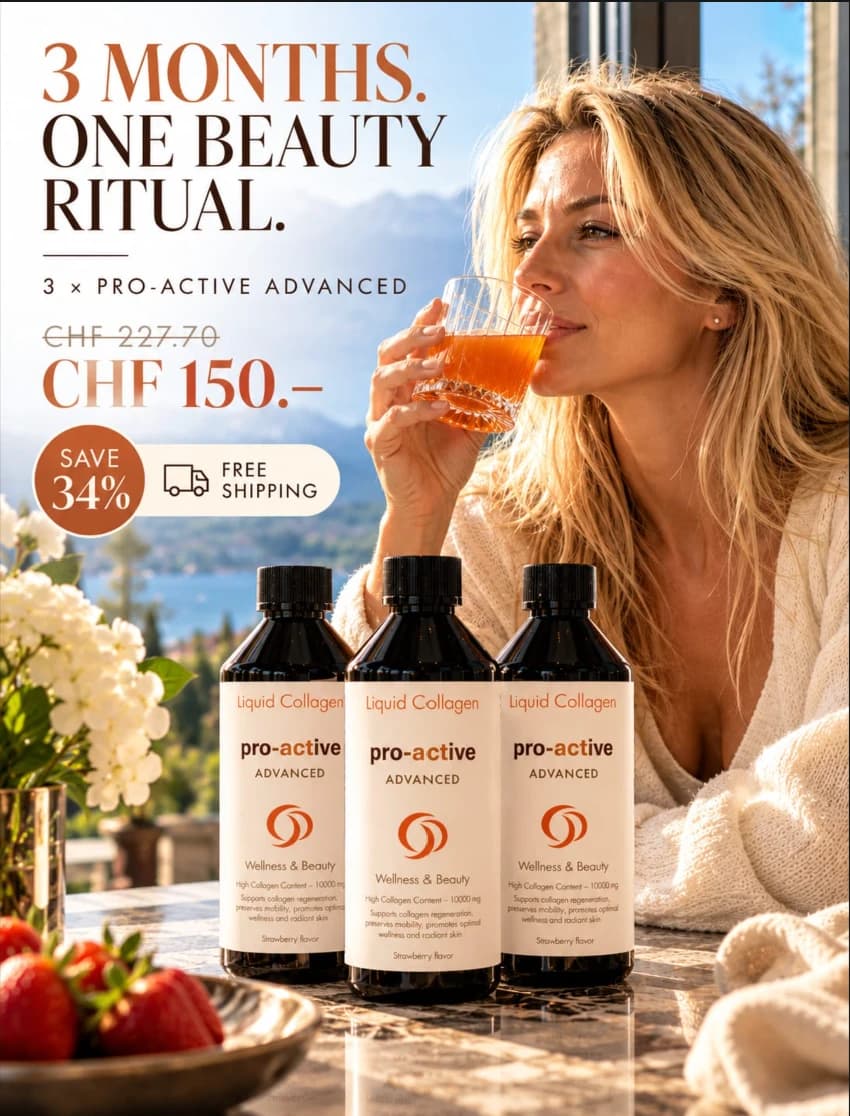
Hydrolysed collagen peptides are a prime example of well-designed bioavailability: enzymatically broken down into short, easily absorbed fragments, immediately available in liquid form, and combined with vitamin C as a co-factor. The Liquid collagen from Bettervita follows precisely this principle – 10,000 mg of Type I and III peptides combined with vitamin C, hyaluronic acid, zinc and silicon, in a form that the body can actually absorb. The article explains what this does in the body Collagen from the age of 30.
It is not the number on the label that matters, but how much of it actually reaches the body. Bioavailability is the invisible dose.
Beauty begins from within.
Knowledge is the first step — application is the second. Liquid Collagen Pro-Active Advanced: high-dose, bioavailable, developed in Switzerland.
Discover the product →Collagen Pro-Active Advanced
Stress, cortisol and the skin: Why tension shows on your face
Chronic stress raises cortisol levels – this slows down collagen production and weakens the skin barrier. How stress manifests itself on the skin, and what really helps.

Silicon: The forgotten element for connective tissue, hair and nails
Silicon helps to stabilise the collagen network and is associated with stronger nails and healthier hair. What the research says about this underrated element.

Collagen for athletes: tendons, ligaments and faster recovery
Taking collagen peptides with vitamin C before a workout can support tendons and ligaments. What studies show – and who might benefit from this.
Comments
No comments yet. Be the first to comment.
Write a comment