
Liquid, powder or tablets - which food supplements work best?
A scientific comparison: bioavailability, absorption speed and ease of use Anyone who buys a dietary supplement usually pays attention to the ingredients and dosage. But
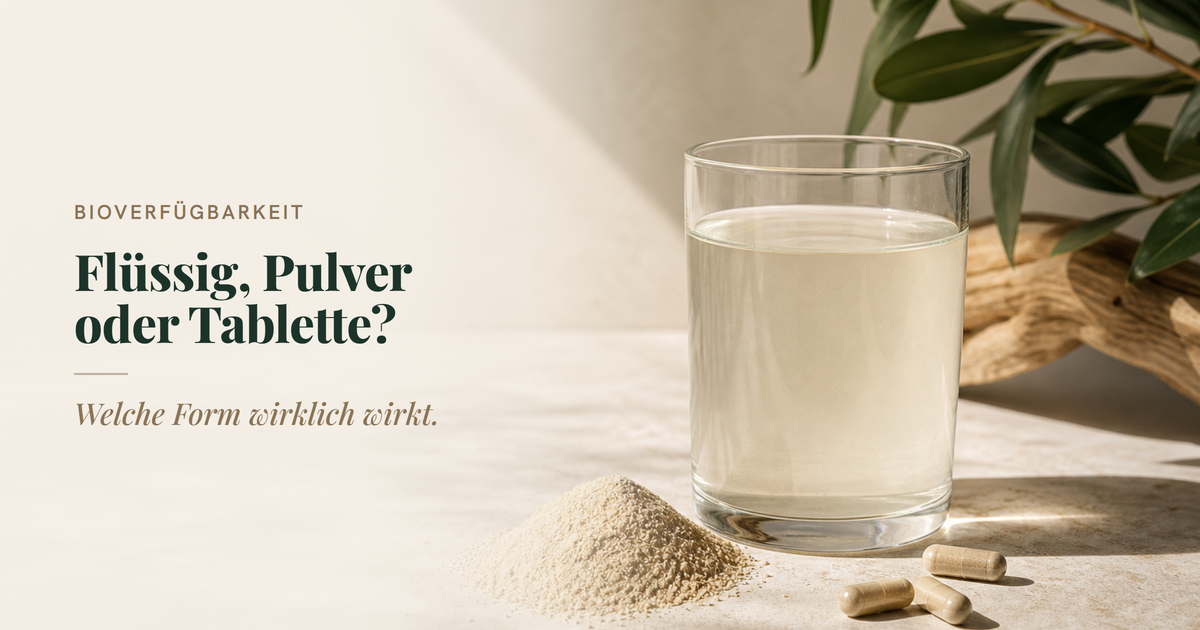
A scientific comparison: bioavailability, absorption speed and ease of use
Anyone who buys a dietary supplement usually pays attention to the ingredients and the dosage. But one crucial factor is often overlooked: the dosage form. This is precisely what determines how much of the active ingredients actually reach the body - and how quickly.
Tablets, capsules, powders or liquids: Each format has its strengths and weaknesses. In this article, we look at what science has to say about the three most common forms - and which form ultimately delivers the most reliable effect.
Bioavailability - why this term makes all the difference
Bioavailability describes the proportion of an active ingredient that actually enters the bloodstream after ingestion and is available to the body. It is not the same as the „content“ of a product: the label may say 1,000 mg - but what is relevant is how much of it is absorbed.
Three steps influence what arrives in the end:
- Decay - how quickly the mould dissolves in the digestive tract
- Resolution - whether the ingredients are converted into an absorbable, dissolved form
- Resorption - how efficiently the intestinal wall absorbs the molecules
Only when all three steps are successful does the active ingredient arrive where it is supposed to work. If one of these steps is disrupted or slowed down, a significant proportion of the dose is lost.
Tablets: Stable and accurate dosing - but slow
Tablets are the classic format. They are inexpensive, have a long shelf life and allow high dosages per tablet. However, their compactness is also their weakness.
What science says:
- The United States Pharmacopeia (USP) requires that a standard tablet be used within 30 to 45 minutes completely disintegrates. Gastro-resistant tablets may even remain undecomposed in the stomach for up to two hours.
- An investigation in the Journal of Pharmacy and Pharmaceutical Sciences tested 39 vitamin and mineral tablets on the Canadian market: 21 of these did not completely disintegrate after 20 minutes in simulated digestive fluid - more than half. Four out of ten capsules also failed the test.
- A double-blind study on iron absorption showed that iron from tablets is only absorbed after about four hours led to recognisably increased serum levels - from liquid form already after two hours.
There are also excipients such as binders, fillers, anti-caking agents and coatings, which make up the weight of the tablets and can also delay absorption. People with reduced stomach acidity, older people or those with conditions such as irritable bowel syndrome, coeliac disease or Crohn's disease often absorb significantly less active ingredient from tablets because their digestive system is unable to break them down reliably.
Strengths: Long shelf life, precise dosing, high amount of active ingredient per unit, easy to take along
Weaknesses: Long disintegration time, dependent on digestive capacity, many excipients, often difficult to swallow
Powder: Better resolution, more effort
Powders solve part of the problem of tablets: they have a much larger surface area and dissolve more quickly as soon as they are stirred in liquid. This significantly shortens the dissolution step.
What science says:
- A review article from 2022 concludes that powders and liquids are absorbed faster than tablets or capsules in most cases, provided they are mixed correctly.
- In the case of hydrolysed collagen peptides, the advantage of the already comminuted form is particularly clear: their resorption rate is increased by over 90 % compared to less than 27 % for non-hydrolysed collagen from food.
But powders have practical hurdles:
- They must be freshly prepared - lumps or insufficient dissolution in cold liquid reduce absorption.
- Hygroscopic substances attract moisture, which shortens the stability after opening.
- Dosing with a measuring spoon is less precise than with tablets or ready-portioned liquids.
- Depending on the active ingredient, the taste and consistency are perceived as unpleasant, which reduces adherence to treatment.
Strengths: Flexible dosing, good absorption after dissolution, often without binder
Weaknesses: Preparation effort, storage stability after opening, measurement uncertainty, sensory acceptance
Liquid form: The fastest route into the bloodstream
Liquid food supplements are already dissolved. They therefore skip two of the three critical steps - disintegration and dissolution - and are immediately available to the body for absorption.
What science says:
- In the iron study mentioned above after two hours significantly higher serum iron levels measurable after liquid intake - twice as fast an effect as with tablets.
- Pilot studies on the bioavailability of vitamin B12 have shown that the absorption rate from liquid formulations is significantly higher than from solid forms.
- Sublingual vitamin B12 drops reach plasma peaks after around 20 minutes, because some of them are absorbed directly through the oral mucosa.
- In the case of collagen, studies have shown that hydrolysed peptides within one to three hours are detectable in blood plasma after ingestion - their short-chain, pre-dissolved form makes complete digestion unnecessary.
Strengths:
- No waiting time for disintegration or dissolution
- Even distribution of the active ingredients in each dose
- Easy to swallow - ideal for people with swallowing difficulties, older people and those with sensitive digestion
- allows the combination of several active ingredients in a single drinking dose
- Can usually be formulated with significantly fewer additives
- Greater adherence to therapy - a pleasant flavour facilitates daily intake
Please note:
- shorter shelf life after opening (refrigerated storage recommended)
- Greater effort required for preservation - sensitive ingredients require careful formulation
- Larger volume per dose (e.g. 25 ml) - not a disadvantage, but practical to consider
Comparison at a glance
Collagen - a special case in which shape is particularly important
Collagen is an illustrative example of how crucial the form of administration is. Natural collagen consists of very large protein molecules that the digestive tract must first break down. Only when the collagen is broken down into short peptides (fragments of 2 to 30 amino acids) can the body absorb it and use it for skin, bones, cartilage and connective tissue.
The manufacturer can already accept this splitting: With the so-called hydrolysed collagen the molecule is enzymatically broken down into small bioactive peptides before bottling. Studies show that these peptides have an absorption rate of over 90 % and in liquid form, dissolved in water, they do not have to swell, overcome binding agents or dissolve first. They are ready for immediate use.
This is precisely why liquid collagen is becoming increasingly important in modern nutricosmetics: less effort, more active ingredient where it is needed.
Which format suits which need?
The choice of the right form depends on what an active ingredient has to achieve:
- For Stable, high-dose active ingredients without absorption problems (e.g. simple minerals), tablets are practical.
- For Active ingredients that should work quickly and completely - vitamins, amino acids, collagen peptides - the liquid form is clearly superior.
- For flexible sports nutrition powders remain unrivalled - also because of the high possible doses.
However, if the aim is to achieve visible effects on the skin, hair, nails or joints, then what counts is the amount of active ingredient that actually reaches your cells. And this is simply highest in liquid form.
Conclusion: the shape is part of the effect
Science paints a clear picture: for most micronutrients, peptides and sensitive active ingredients, the liquid form is superior because it skips two of the three critical steps of bioavailability. Powders are a distant second, provided they are prepared correctly. Tablets are justified - but their compactness is a disadvantage, especially for sensitive active ingredients such as collagen peptides.
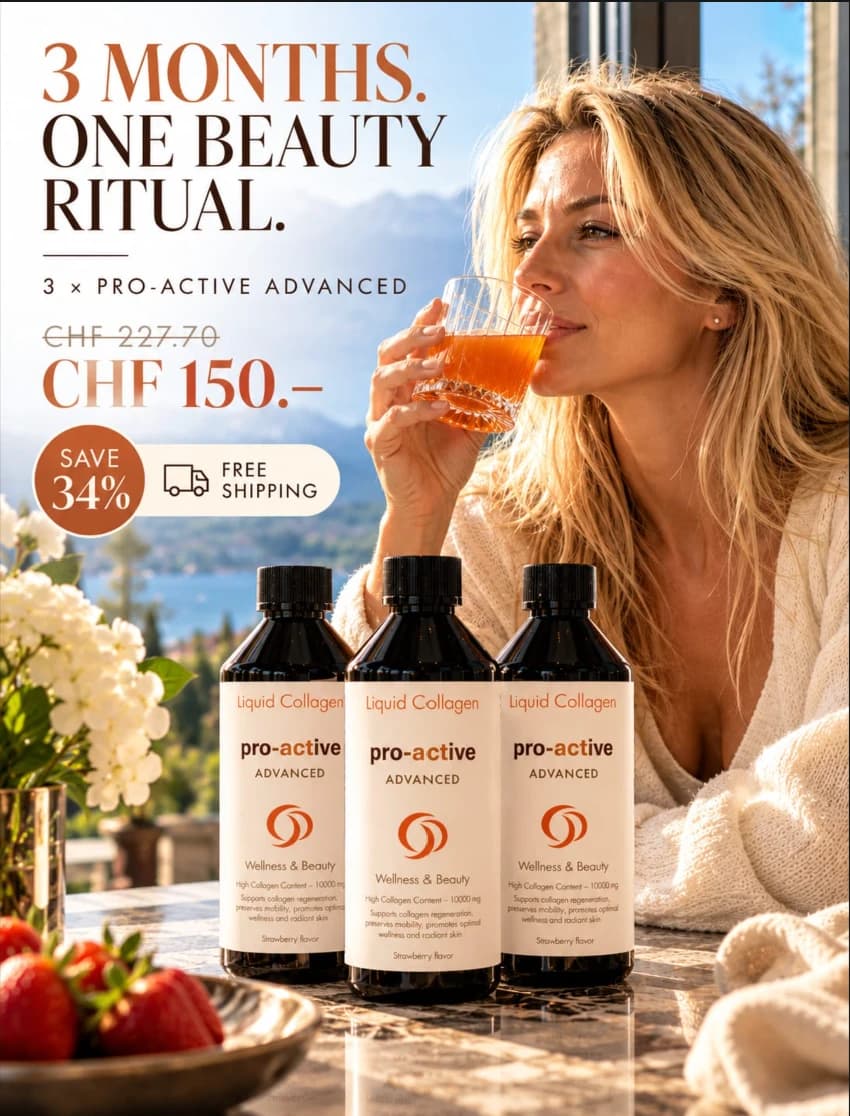
If you're looking for visible results - smoother skin, stronger hair, healthier joints - it's worth taking a look at premium liquid formulations. A good example is our Liquid Collagen Pro Active Advanced10,000 mg hydrolysed, highly bioavailable collagen peptides type I and III per daily dose, supplemented with hyaluronic acid, zinc, biotin and vitamins - ready for immediate use, without mixing, without excipient ballast.
Because when it comes to food supplements, it's not what it says on the label that counts. It's what actually arrives.
Beauty begins from within.
Knowledge is the first step — application is the second. Liquid Collagen Pro-Active Advanced: high-dose, bioavailable, developed in Switzerland.
Discover the product →Collagen Pro-Active Advanced
Stress, cortisol and the skin: Why tension shows on your face
Chronic stress raises cortisol levels – this slows down collagen production and weakens the skin barrier. How stress manifests itself on the skin, and what really helps.

Silicon: The forgotten element for connective tissue, hair and nails
Silicon helps to stabilise the collagen network and is associated with stronger nails and healthier hair. What the research says about this underrated element.

Collagen for athletes: tendons, ligaments and faster recovery
Taking collagen peptides with vitamin C before a workout can support tendons and ligaments. What studies show – and who might benefit from this.
Comments
No comments yet. Be the first to comment.
Write a comment