
Strong bones from the age of 40: the underestimated importance of collagen
The organic bone matrix consists of around 90 % of collagen. Why bone density declines from the age of 40, what measures can help protect it, and what studies on collagen peptides and bone density reveal.
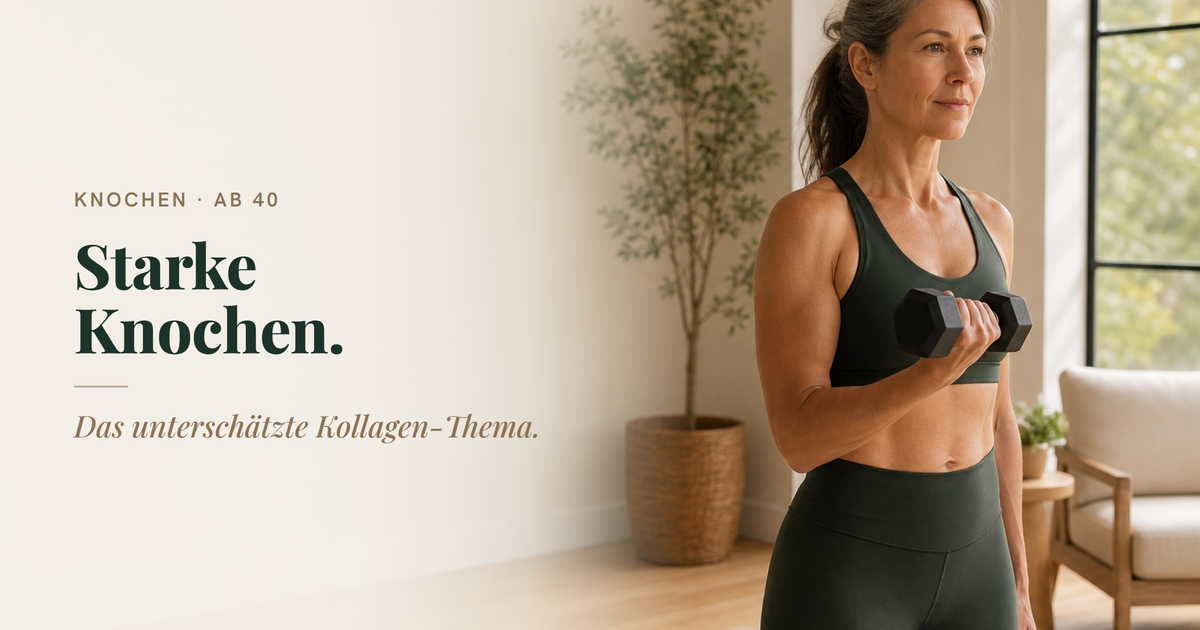
When we think of bones, we think of something hard, dead and mineral-like. In fact, bone is living tissue – and its structure consists of around 90 % made from collagen. The minerals are deposited on this collagen network. From around the age of 40, and particularly in women going through the menopause, this balance begins to falter.
Bones are living tissue
Bone undergoes a lifelong process of remodelling: certain cells break it down, whilst others rebuild it. The collagen framework (the organic matrix) provides the bone with Tensile strength and flexibility, the minerals (particularly calcium) provide hardness. Together, they make the bone strong – a bone consisting purely of minerals would be as brittle as chalk.
Why from the age of 40 – and during the menopause
People reach their peak bone mass around the age of 30. After that, bone loss gradually begins to outweigh bone formation. In women, the A drop in oestrogen levels during the menopause This process is clear – oestrogen normally slows down bone loss. This explains the increased risk of osteoporosis after the menopause.
The keys to strong bones
- Strength training and weight-bearing exercise: The strongest stimulus – mechanical load stimulates the bone-forming cells.
- Enough protein: The bone matrix consists largely of protein.
- Calcium, vitamin D and vitamin K2: for mineralisation and its proper management.
- Collagen peptides provide building blocks for the organic matrix.
What research into collagen shows
In a randomised controlled trial conducted by König et al. (2018) Postmenopausal women took specific collagen peptides or a placebo daily for one year. The active treatment group showed a significantly improved bone density – the peptides stimulated the formation of the bone matrix. Important: This is a supplementary treatment, not a substitute for medical treatment for osteoporosis.
Bones and skin – the same protein
It’s the same story as with the skin, only deeper within the body: Type I collagen is the building block common to both skin and bone. Anyone who supports it from within – with vitamin C as a co-factor – as in the Liquid collagen from Bettervita, is good for both. It describes how the loss begins, Collagen from the age of 30; the following applies to the joints Prevention instead of repair.
Bones are not dead minerals, but a living collagen framework. If you look after them from the age of 40, you’ll be on firmer ground by the time you’re 70.
Beauty begins from within.
Knowledge is the first step — application is the second. Liquid Collagen Pro-Active Advanced: high-dose, bioavailable, developed in Switzerland.
Discover the product →Collagen Pro-Active Advanced
Stress, cortisol and the skin: Why tension shows on your face
Chronic stress raises cortisol levels – this slows down collagen production and weakens the skin barrier. How stress manifests itself on the skin, and what really helps.

Silicon: The forgotten element for connective tissue, hair and nails
Silicon helps to stabilise the collagen network and is associated with stronger nails and healthier hair. What the research says about this underrated element.

Collagen for athletes: tendons, ligaments and faster recovery
Taking collagen peptides with vitamin C before a workout can support tendons and ligaments. What studies show – and who might benefit from this.

Comments
No comments yet. Be the first to comment.
Write a comment