
Collagen during the menopause
With menopause, oestrogen falls — and with it the body's own collagen production. Skin becomes thinner, joints stiffer, connective tissue loses its firmness. Liquid collagen peptides target exactly this. Here's why it happens and what genuinely helps.

Key facts at a glance
In the first five years after menopause, skin can lose up to 30 % of its collagen — most of it in the first 12 to 18 months. The cause is the falling oestrogen level, which governs collagen and hyaluronic acid synthesis in connective tissue. Hydrolysed collagen peptides supply the building blocks to counteract this.
- —Oestrogen deficiency slows the body's own collagen formation.
- —Up to 30 % collagen loss in the first five years of menopause.
- —Liquid peptides — the daily dose in 25 ml, ready to drink.
- —10'000 mg per daily dose for skin, joints and connective tissue.
Why collagen drops during the menopause.
Oestrogen is a key regulator of connective tissue: it keeps the fibroblasts active that produce collagen and hyaluronic acid in the skin. When oestrogen falls in perimenopause and menopause, this production slows dramatically — while natural breakdown continues unabated. The result is a noticeable net loss of collagen.
Studies show that skin collagen already declines measurably in the first year after the last period, by up to 30 % over the first five years. It shows as thinner skin, fine lines, less firmness — and often stiffer joints too. Collagen peptides taken orally give the body the amino acids it needs to rebuild.
What matters for collagen during the menopause.
Not every collagen product works the same. Three factors decide whether the peptides reach the connective tissue — precisely in a phase when the body needs them most.
A sufficient dose
For a noticeable effect you need 5'000 to 10'000 mg of collagen peptides per day. Under-dosed capsules rarely reach that amount — one daily dose of Pro-Active delivers the full 10'000 mg.
Hydrolysed & bioavailable
Only hydrolysed peptides are short-chained enough to be absorbed through the gut. A ready-to-drink shot delivers the full daily dose without mixing.
Consistent intake
Collagen works cumulatively. First effects appear after 8 to 12 weeks of daily intake — a ready-to-drink shot makes the daily ritual easy to keep up.
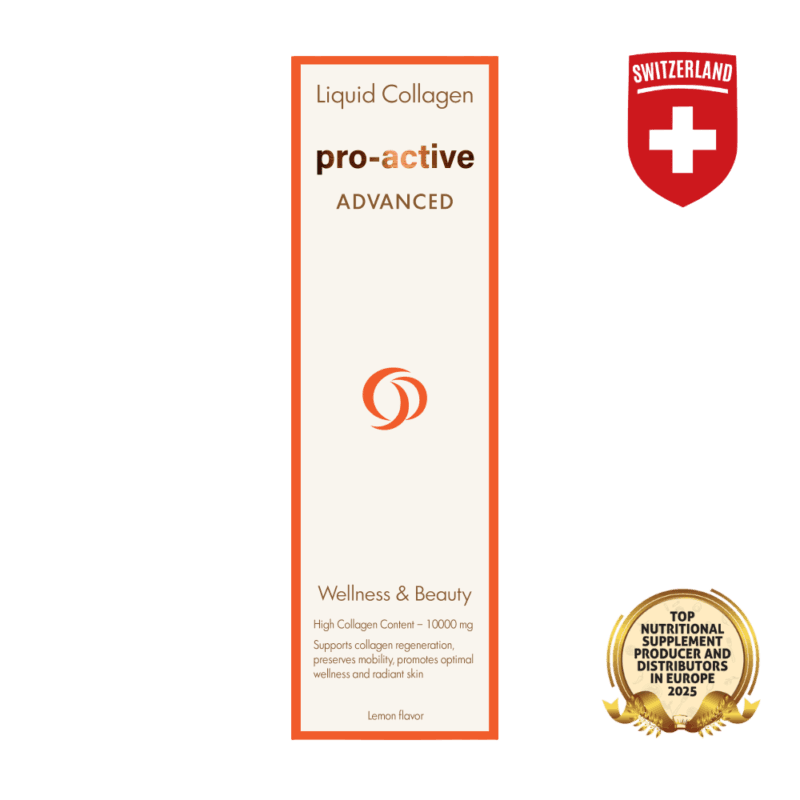
Collagen Pro-Active Advanced
Liquid collagen for the menopause
10'000 mg of hydrolysed collagen peptides per daily dose, combined with hyaluronic acid, biotin, vitamin C and zinc — exactly the building blocks connective tissue lacks during the menopause. Ready to drink, developed in Switzerland.
10'000 mg of collagen peptides (Fortigel®) per 25 ml With hyaluronic acid, biotin, vitamin C and zinc Ready to drink — no mixing, no clumps Supports skin, joints and connective tissue
Related articles from the journal
Skin during the menopause: why collagen levels drop
What happens to connective tissue in perimenopause and menopause — and what really helps.
JournalCollagen from 30: what happens in the body
From 25, your own production falls each year. How to counteract it early.
JournalWhy does our skin age — and what really helps?
The mechanisms of skin ageing and the role of nutrition from within.
Collagen & menopause — your questions
Does collagen really help during the menopause?
Yes. The oestrogen drop slows the body's own collagen production, so skin and connective tissue lose collagen measurably. Hydrolysed collagen peptides supply the amino acids the body needs to rebuild. Studies show improved skin elasticity and hydration after 8 to 12 weeks of daily intake.
How much collagen should I take during the menopause?
5'000 to 10'000 mg of hydrolysed collagen peptides per day are recommended. Collagen Pro-Active Advanced delivers the full 10'000 mg in a ready-to-drink 25 ml daily dose.
When should I start with collagen?
It makes sense to start as early as perimenopause, when oestrogen begins to fluctuate — often from your mid-40s. The earlier you counteract, the less collagen is lost in the first, most depleting years.
Does collagen replace hormone therapy?
No. Collagen peptides are a food supplement, not a hormone treatment. They can help cushion collagen loss as a complement, but do not replace a medically prescribed therapy. For medical questions, talk to your doctor.
When will I see first results?
Many users report more skin hydration and firmer nails after 4 to 8 weeks. For visible improvements in skin elasticity, studies recommend a course of at least 8 to 12 weeks.
Give your connective tissue back what oestrogen takes away.
Start your daily collagen ritual — 10'000 mg of liquid peptides, developed in Switzerland.
Buy Pro-Active