
Hair, skin, and nails — which nutrients do they really need?
Shiny hair, firm skin, strong nails – hardly any area of personal care is flooded with so many promises as

Shiny hair, firm skin, strong nails – hardly any area of personal care is flooded with as many promises as beauty supplementation. But which nutrients actually deliver on their promises? And which ones are, above all, expensive?
Anyone browsing a pharmacy or online shop today will inevitably come across shiny packaging with promises like «Stronger hair in 4 weeks» or «Youthful skin from within». The list of active ingredients reads impressively: biotin, collagen, silicon, hyaluronic acid, vitamin C, zinc. But what's really behind it all?
In this article, we'll take a close look at the six most important nutrients – sober, evidence-based, and without marketing spin. Because those who shop with information make better decisions.
The six nutrients at a glance
1. Biotin (Vitamin B7) — Evidence: Moderate
Biotin is arguably the best-known «beauty nutrient» of all. This water-soluble B vitamin is involved in the synthesis of keratin – the structural protein that makes up hair and nails. It sounds logical, and indeed the connection is evidenced by research – but with one important caveat.
🔬 What science says: Biotin supplementation shows a clear effect in cases of proven biotin deficiency: hair loss stops and nail quality improves measurably. Several case reports and small clinical studies confirm this. The problem: Genuine biotin deficiency is extremely rare in Western populations.
⚠️ What marketing makes of it: Manufacturers often broadly advertise biotin as a «hair vitamin» – without providing the crucial context that its effects are primarily significant in cases of deficiency. Those who already consume sufficient biotin through their diet (eggs, nuts, legumes) will hardly benefit from extra doses.
Another critical point: High-dose biotin (often 5,000–10,000 µg in supplements) can falsify laboratory values such as thyroid values and troponin. This is a known problem in medicine — and should always be mentioned when visiting the doctor.
- Recommended daily dose: 30–100 µg (EU reference value: 50 µg). Typical supplements contain 100–200 times this amount.
- Natural sources Eggs (especially yolks), liver, nuts, legumes, avocado, salmon.
2. Zinc — Evidence: Strong (in case of deficiency)
Zinc is an essential trace element that is involved in more than 300 enzymatic reactions in the body. It is indispensable for hair, skin, and nails: it regulates cell division, supports wound healing, and is involved in the construction of keratin structures.
A zinc deficiency – which is more common than a biotin deficiency, especially in vegetarians, vegans, and the elderly – classically manifests as brittle nails, increased hair loss (telogen effluvium), and reduced skin wound healing.
🔬 What science says: Several randomised controlled trials show that zinc supplementation significantly reduces diffuse hair loss in individuals with a confirmed deficiency. Interestingly, some studies show similar effects to low-dose minoxidil. However, for people without a deficiency, the benefit is marginal.
Zinc is one of the few minerals where excessive supplementation can become problematic: permanent doses over 40 mg daily can inhibit copper absorption and lead to a copper deficiency in the long term.
- Recommended daily dose: 7–11 mg/day. Supplementation: 15–25 mg, preferably as zinc bisglycinate (high bioavailability).
- Natural sources Oysters, red meat, pumpkin seeds, legumes, quinoa, whole grains.
3. Vitamin C (Ascorbic acid) — Evidence: Very strong
Vitamin C holds a special place among beauty nutrients — because its effects are exceptionally well scientifically proven and go far beyond pure cosmetics. As a powerful antioxidant, it neutralises free radicals, which are generated by UV radiation, air pollution, and oxidative stress, and damage skin, hair, and nails.
More importantly: Vitamin C is absolutely essential for collagen synthesis. Without sufficient Vitamin C, the body cannot produce functional collagen – the extreme example being scurvy, where skin, connective tissue, and nails break down. However, even subclinical deficiencies manifest as dull hair, rough skin, and slower wound healing.
🔬 What science says: The evidence for vitamin C as a cofactor in collagen synthesis is undeniable and well-understood at a molecular level. It is essential for the hydroxylation of proline and lysine – two amino acids crucial for the stability of the collagen triple helix. Without vitamin C, the body produces unstable, inferior quality collagen.
Vitamin C also acts as a potent enhancer of iron absorption – relevant as iron deficiency is a common but often overlooked cause of hair loss in women.
- Recommended daily dose: 80–110 mg/day. For antioxidant protection and collagen synthesis: 200–500 mg is sensible, especially liposomal vitamin C for better absorption.
- Natural sources Acerola cherry, rosehip powder, paprika, blackcurrant, kale, broccoli, citrus fruits.
4. Silicon (Silica) — Evidence: Promising
Silicon – most often offered in supplements as organic silicic acid (orthosilicic acid) or bamboo extract – is one of the most overlooked trace elements for skin, hair, and nails. The human body contains about 7 grams of it, concentrated in bones, cartilage, connective tissue, skin, and hair.
Silicon is involved in the cross-linking of collagen and elastin fibres and appears to promote hyaluronic acid synthesis in the skin. As we age, silicon levels in the tissue significantly decrease – in parallel with signs of aged skin and brittle hair and nails.
🔬 What science says: A double-blind, placebo-controlled study (Barel et al., 2005) showed that orally ingested choline-stabilised orthosilicic acid significantly improved hair diameter and tensile strength over 20 weeks. Further studies suggest positive effects on nail brittleness and skin elasticity.
What marketing often doesn't tell you: Not all silicic acids are equally well absorbed. Colloidal silicic acid and many plant extracts have significantly lower bioavailability than stabilised ortho-silicic acid. The dosage form really makes a big difference here.
- Dosage in studies: 10 mg of ortho-silicic acid daily showed the best results. Bamboo extracts: 300–600 mg/day.
- Natural sources Oats, whole grains, bananas, green beans, mineral water high in silicic acid.
5. Vitamin D3 — Evidence: Strong (particularly in winter)
Vitamin D3 is much more than the «sunshine vitamin» – it is actually a steroid hormone with far-reaching effects on virtually every tissue in the body. It is particularly relevant for hair, skin, and nails, as vitamin D receptors have been detected in hair follicles, keratinocytes, and skin fibroblasts.
In Switzerland and generally in northern latitudes, vitamin D deficiency is widespread: estimates suggest that up to 60% of the population have suboptimal levels in winter. This has direct consequences for the hair growth cycle.
🔬 What science says: Several studies show an association between low vitamin D levels and diffuse hair loss (telogen effluvium) as well as alopecia areata. Vitamin D appears to be essential for the correct passage of the hair follicle through the growth and resting phases.
⚠️ Important notice: Vitamin D3 should always be taken together with vitamin K2 (MK-7), as K2 ensures the correct utilisation of calcium. Furthermore, vitamin D3 is better absorbed when dissolved in fat — it is best taken with a meal.
- Optimal serum level 40–60 ng/ml (100–150 nmol/l). Only a blood test will show if supplementation is necessary.
- Recommended dosage 1,000–4,000 IU daily (depending on baseline value). Combination with K2 (100–200 µg MK-7) recommended.
6. Collagen Peptides — Evidence: Growing and Solid
Collagen peptides have become an indispensable part of the beauty supplement market — and they have also become increasingly interesting scientifically in recent years. Collagen accounts for about 30 % of the total protein in the human body and is the structural framework of skin, connective tissue, bones, and hair.
Mit dem Alter sinkt die körpereigene Kollagensynthese: Ab etwa 25 Jahren nimmt sie um ca. 1 % pro Jahr ab, mit 50 Jahren produziert der Körper rund 35 % weniger Kollagen als in jungen Jahren. Die Folgen sind bekannt: Faltenbildung, nachlassende Hautelastizität, dünnere Haare.
«The exciting thing about collagen peptides is not only that they provide building blocks – but that they act as bioactive signalling molecules that stimulate fibroblasts to produce their own collagen.»
🔬 What science says: A 2021 meta-analysis (Baranowska & Kowalska), involving 19 studies, demonstrated that daily intake of 2.5–10 g of hydrolysed collagen for at least 8 weeks significantly improved skin hydration, elasticity, and the depth of fine lines. A study on nails (Hexsel et al., 2017) showed a 12% increase in growth and 42 % fewer brittle nails after 24 weeks.
What marketing often doesn't tell you: (1) The origin and quality of collagen vary greatly – marine collagen is considered to be more bioavailable than bovine collagen. (2) Collagen is not a «complete» protein – it lacks the essential amino acid tryptophan. (3) Without sufficient vitamin C, collagen peptides are only half as effective, as vitamin C is essential for incorporation into tissue.
The molecule size is crucial: hydrolysed collagen with a molecular weight below 5,000 Daltons has been shown to be absorbed in the small intestine and enters the bloodstream as di- and tripeptides. Intact collagen (as found in some bone broths), on the other hand, is completely digested and has hardly any specific effect.
- Evidence-based dosing: 2.5–10 g hydrolysed collagen daily, for at least 8–12 weeks continuously. Combination with vitamin C is essential.
- What to look out for: Molecular weight < 5,000 Da, marine collagen types I & III, no additives, transparent sourcing.
Summary: Science vs. Marketing
How do I recognise quality?
Not every supplement is the same. When buying, it's worth paying attention to the following points:
- Transparent origin of raw materials (especially important for collagen)
- Independent laboratory analyses and certificates of purity (e.g. Informed Sport, NSF)
- Sensible dosage form: Collagen as hydrolysate, zinc as bisglycinate, vitamin D3 with K2
- No excessively long lists of additives (fillers, artificial colours)
- Dosing within the recommended limits — more is not always more
- Produced to GMP (Good Manufacturing Practice) standard
The be-all and end-all: the basics first
Supplements can supplement a balanced diet – but never replace it. Before reaching for capsules, an honest look at your daily routine is worthwhile:
Protein intake Hair is composed of approximately 90 % keratin – a protein. If you consume too little protein (guideline: 1.2–1.6 g per kilogram of body weight), no supplement can counteract this.
Iron mirror Iron deficiency is one of the most common, yet most overlooked, causes of hair loss in women. A simple blood test (ferritin) will provide clarity.
Hydration: Sufficient water is fundamental for skin elasticity and circulation to the hair follicles. No pill can replace 2 litres daily.
Sleep and stress: Chronic stress increases cortisol – a known trigger for telogen effluvium (diffuse hair loss). No supplement in the world can compensate for chronic sleep deprivation.
Conclusion: Less is more — and knowledge is everything
The good news is that you don't need ten supplements or astronomical expenses to support your hair, skin, and nails from the inside. If you proceed with a targeted approach, you'll save money and achieve better results.
Vitamin C is sensible for almost everyone. Vitamin D3 should not be ignored in the Swiss winter — a blood test is the smart start. Zinc and Biotin are worth it in case of a genuine shortage. Collagen peptides are a sensible supplement when chosen and dosed correctly — but only in conjunction with vitamin C. And Silicon is an underrated player to keep an eye on.
What remains: nutrition, sleep, stress management, and sufficient protein are the foundation – on which every nutrient can truly work.
Note: This article is for informational purposes only and does not replace medical advice. If you experience persistent symptoms such as hair loss, nail changes, or skin problems, you should always consult a doctor. The studies mentioned are freely accessible in common scientific databases (PubMed).
Beauty begins from within.
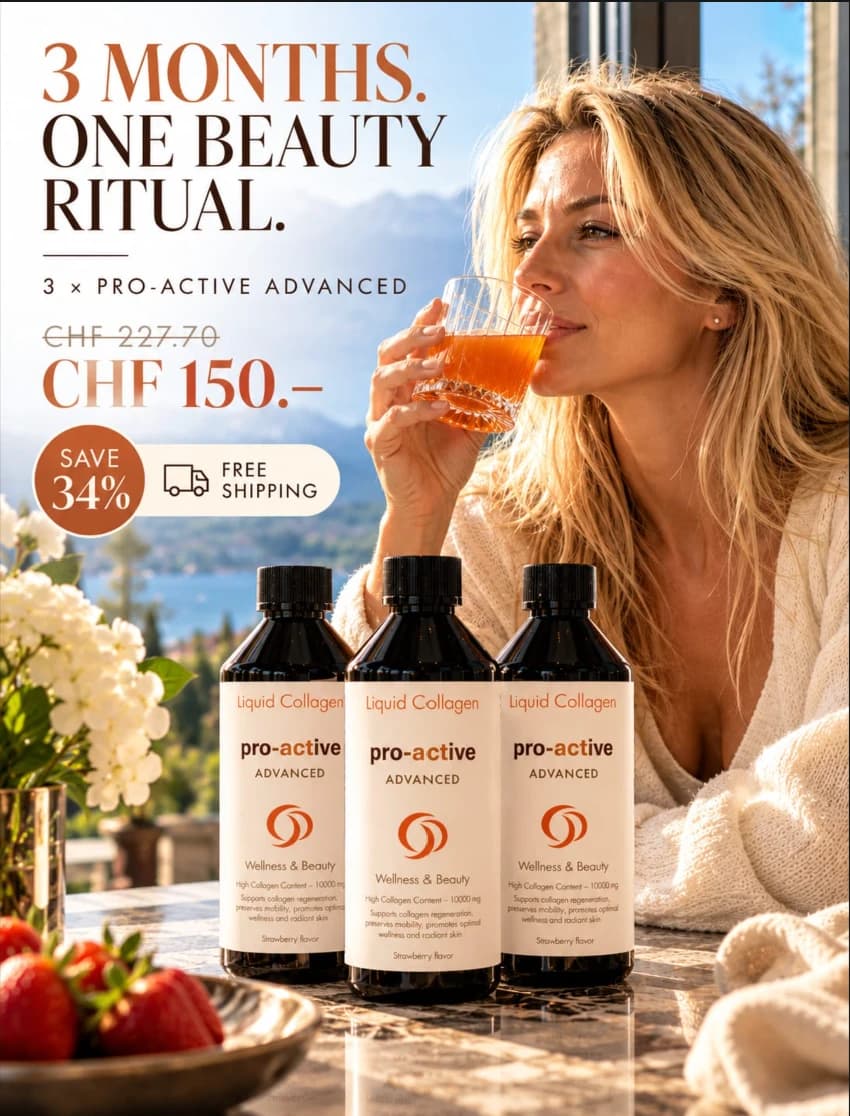
Knowledge is the first step — application is the second. Liquid Collagen Pro-Active Advanced: high-dose, bioavailable, developed in Switzerland.
Discover the product →Collagen Pro-Active Advanced
Stress, cortisol and the skin: Why tension shows on your face
Chronic stress raises cortisol levels – this slows down collagen production and weakens the skin barrier. How stress manifests itself on the skin, and what really helps.

Silicon: The forgotten element for connective tissue, hair and nails
Silicon helps to stabilise the collagen network and is associated with stronger nails and healthier hair. What the research says about this underrated element.

Collagen for athletes: tendons, ligaments and faster recovery
Taking collagen peptides with vitamin C before a workout can support tendons and ligaments. What studies show – and who might benefit from this.
Comments
No comments yet. Be the first to comment.
Write a comment