
Hyaluronic acid: What really works – and what’s just hype
Serums, injections or fillers – hyaluronic acid is often misunderstood. We look at the validity of the five most common claims, what studies say about its use, and what really matters when it comes to hyaluronic acid.

Serums, shots, drinkable ampoules, fillers – few active ingredients are as ubiquitous as hyaluronic acid. And few are as frequently misunderstood. We separate fact from fiction.
What hyaluronic acid is
Hyaluronic acid is a molecule produced naturally by the body – a glycosaminoglycan that binds water like almost no other substance: up to 1,000 times its own weight. Around half of the body’s hyaluronic acid is found in the skin, where it plumps up the tissue and keeps it moisturised. As we age – and in the Menopause In addition, due to the drop in oestrogen, the level decreases. The skin appears less plump.
Myth 1: „Hyaluronic acid cream permanently plumps out wrinkles“ – HYPE
Topical hyaluronic acid is a humectant: It binds water at the surface, making the skin appear smoother and plumper for a short time. However: High-molecular-weight hyaluronic acid is too large to penetrate the deeper layers of the skin (dermis). It does not permanently fill in wrinkles – the effect is temporary plumping, not a restructuring of the skin.
Myth 2: „Hyaluronic acid is always good in dry air“ – PARTLY
Because hyaluronic acid attracts water, it can have the opposite effect in very dry air: if it finds no moisture on the surface, it draws water up from the deeper layers of the skin – and can actually dry the skin out. The trick: apply hyaluronic acid to slightly damp skin and „seal“ it in with a moisturiser.
Myth 3: „Drinking hyaluronic acid is pointless“ – OUTDATED
For a long time, oral hyaluronic acid was considered ineffective. The evidence has now shifted: studies such as Oe et al. (2017) showed that taking hyaluronic acid daily for 12 weeks measurably improved skin hydration and reduced the appearance of wrinkles. The body breaks down hyaluronic acid in the gut into smaller building blocks, which are absorbed and are thought to stimulate the body’s own production. To be honest: the evidence is more recent and less substantial than for collagen peptides – but it is growing. As always, the deciding factor here is Bioavailability.
Myth 4: „The higher the molecular weight, the better“ – PARTLY
It’s not quite that simple. High-molecular-weight hyaluronic acid remains on the surface and forms a protective moisturising film; low-molecular-weight hyaluronic acid penetrates slightly deeper, but is thought to have an inflammatory effect when broken down into very small fragments. „Higher“ does not automatically mean „better“ – it depends on the objective.
Myth 5: „Fillers are the same as hyaluronic acid skincare“ – A MISCONCEPTION
A hyaluronic acid filler is injected directly into the dermis – this is a medical procedure that places the molecule exactly where creams and serums cannot reach. This has nothing to do with hyaluronic acid in skincare products or dietary supplements. The three methods – applying, ingesting and injecting – are fundamentally different and should not be confused.
What counts: the interaction
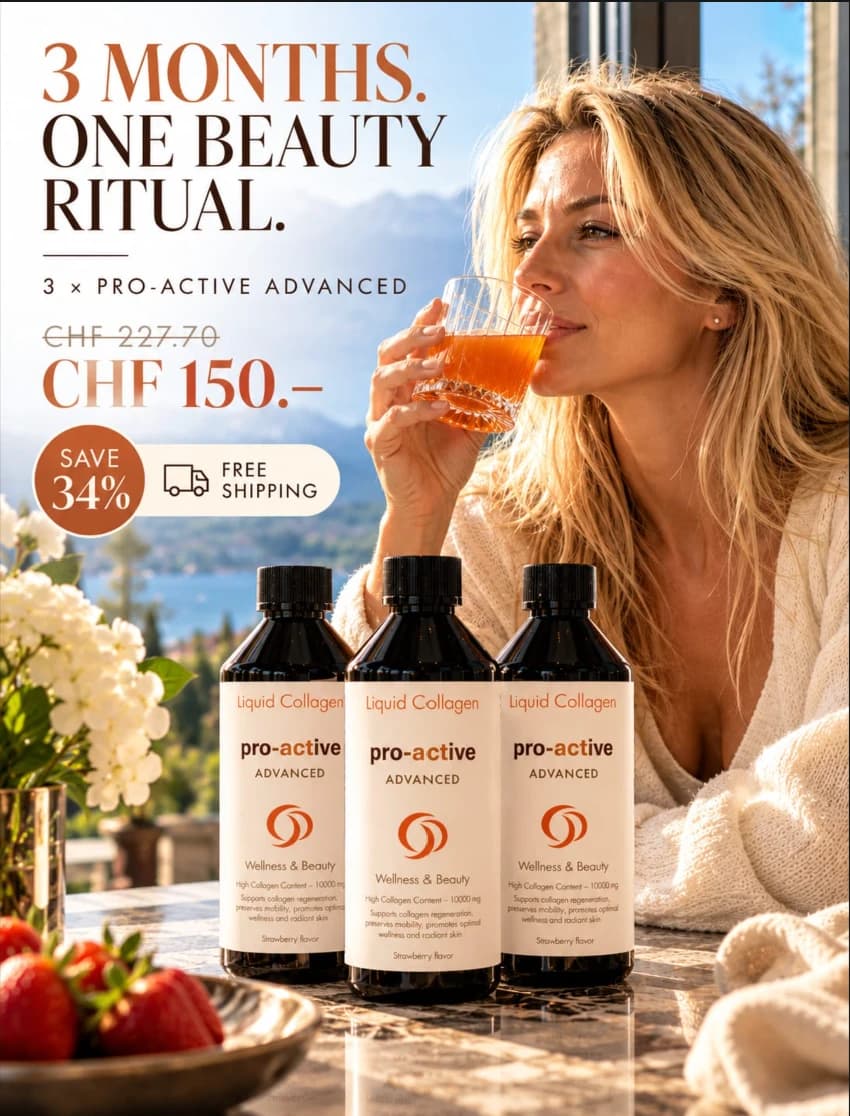
Hyaluronic acid does not work alone. Its ability to bind water is most effective when combined with the substances that make up the tissue: collagen and its co-factor, vitamin C. This is exactly how it works in the Liquid collagen from Bettervita Formula: 20 mg of hyaluronic acid is combined with 10,000 mg of type I and III collagen peptides, plus vitamin C, zinc and silicon. To complement this, it is worth using a vitamin C serum topically as part of the Morning routine.
Hyaluronic acid binds water – but it doesn’t provide structure. That comes from collagen. They work best together.
Beauty begins from within.
Knowledge is the first step — application is the second. Liquid Collagen Pro-Active Advanced: high-dose, bioavailable, developed in Switzerland.
Discover the product →Collagen Pro-Active Advanced
Stress, cortisol and the skin: Why tension shows on your face
Chronic stress raises cortisol levels – this slows down collagen production and weakens the skin barrier. How stress manifests itself on the skin, and what really helps.

Silicon: The forgotten element for connective tissue, hair and nails
Silicon helps to stabilise the collagen network and is associated with stronger nails and healthier hair. What the research says about this underrated element.

Collagen for athletes: tendons, ligaments and faster recovery
Taking collagen peptides with vitamin C before a workout can support tendons and ligaments. What studies show – and who might benefit from this.
Comments
No comments yet. Be the first to comment.
Write a comment