
Vitamin C: The underrated partner in collagen production
Without vitamin C, the body cannot produce stable collagen. How the vitamin supports the skin’s structure, how much is beneficial – and what the research shows.
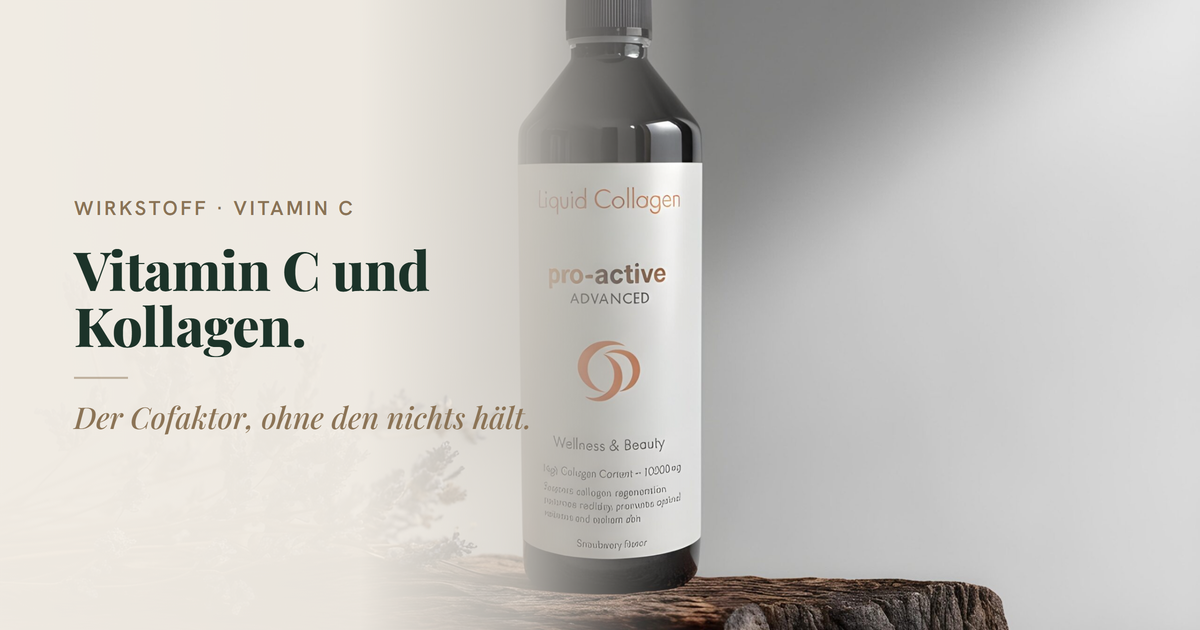
Vitamin C is often thought of as the ‘cold vitamin’ – yet its most important role for the skin is quite different. Without vitamin C, the body simply cannot produce stable collagen. It is not just a nice little extra, but a co-factor without which collagen production grinds to a halt.
The co-factor without which nothing works
Collagen is a structural protein whose strength derives from its structure: three protein chains coil together to form a Triple helix. For this helix to become stable and subsequently cross-link into strong fibres, certain amino acids must undergo chemical modification. This is precisely where vitamin C comes into play: it is an essential cofactor for enzymes Prolyl hydroxylase and Lysyl hydroxylase. Without it – and therefore without vitamin C – only unstable, inferior collagen is produced, which does not hold together properly. In other words: no matter how many building blocks the body provides, without this co-factor it cannot build a stable structure. The fact that the body’s ability to regenerate slows down anyway from a certain age onwards is described by Collagen from the age of 30.
Scurvy: an extreme example from history
Medical history provides a stark illustration of what happens when there is a complete lack of vitamin C. Sailors who spent months at sea without fresh fruit and vegetables developed scurvy: bleeding gums, poorly healing wounds and brittle blood vessels. The common factor underlying all these symptoms is the breakdown of connective tissue – because without vitamin C, stable collagen can no longer be produced. Scurvy is rare today, but it remains the most striking evidence of just how indispensable this co-factor is.
What the research shows
The mechanism is well documented. Pullar et al. (2017) summarise the many roles that vitamin C plays in skin health: it is not only a co-factor in collagen synthesis, but also protects the skin as an antioxidant. And Boyera et al. (1998) showed in cell experiments that vitamin C directly stimulates collagen synthesis in skin fibroblasts – that is, in precisely those cells responsible for replenishing collagen. Taken together, this paints a coherent picture: vitamin C plays a central, rather than a peripheral, role in collagen formation. Both functions – as an enzyme co-factor and as an antioxidant – work towards the same end.
Vitamin C from your plate
The good news is that vitamin C can easily be obtained through your diet. Foods that are particularly rich in it include:
- Berries: Sea buckthorn, blackcurrants and strawberries are rich in vitamin C but contain relatively little sugar.
- Paprika: especially the red one – which contains more vitamin C per unit of weight than a lemon.
- Citrus fruits: Oranges, lemons and grapefruit – the classic combination.
- Cabbage and greens: Broccoli, Brussels sprouts and parsley are underrated sources.
Vitamin C is sensitive to heat and light, so some of it is lost during prolonged cooking. Those who eat a varied diet generally get by just fine. A supplement is particularly useful if your intake fluctuates or if you want to specifically support collagen production – but in that case, it’s important that your body actually absorbs it (more on this at Bioavailability explained simply).
Dual role: protection against UV stress
Vitamin C is also an antioxidant. UV radiation generates free radicals in the skin (oxidative stress), which damage collagen fibres and accelerate their breakdown. As an antioxidant, vitamin C neutralises some of these radicals, thereby slowing down UV-induced collagen breakdown. It therefore not only supports collagen production but also protects existing collagen – which explains why the sun is the biggest factor in skin ageing. the article on the sun and the skin. Of course, it is no substitute for sun protection.
Why the co-factor needs to be taken into account
Collagen peptides provide the building blocks – but without vitamin C, we lack the tool needed to build stable collagen from them. That is why it is no coincidence that in the Liquid collagen from Bettervita in addition to the hydrolysed collagen peptides, also 80 mg vitamin C contains: precisely the co-factor that the enzymes need for cross-linking. Deliberately included, not merely an „additive“ on the label – a building block and a tool in a single liquid serving.
Vitamin C does not build collagen – but without it, the body cannot produce any that lasts. This silent co-factor determines whether building blocks are turned into structure.
Beauty begins from within.
Knowledge is the first step — application is the second. Liquid Collagen Pro-Active Advanced: high-dose, bioavailable, developed in Switzerland.
Discover the product →Collagen Pro-Active Advanced
Stress, cortisol and the skin: Why tension shows on your face
Chronic stress raises cortisol levels – this slows down collagen production and weakens the skin barrier. How stress manifests itself on the skin, and what really helps.

Silicon: The forgotten element for connective tissue, hair and nails
Silicon helps to stabilise the collagen network and is associated with stronger nails and healthier hair. What the research says about this underrated element.

Collagen for athletes: tendons, ligaments and faster recovery
Taking collagen peptides with vitamin C before a workout can support tendons and ligaments. What studies show – and who might benefit from this.

Comments
No comments yet. Be the first to comment.
Write a comment